

People Are Not Line Items
What Pope Leo XIV’s First Encyclical Gets Right About AI and Capitalism

In 2014, I was sitting in a conference room at one of Silicon Valley’s largest social media companies, listening to a senior leader walk through a set of new platform features. He explained, without apology, that they were designed to maximize engagement. The human cost was not part of the equation. He said it plainly, in a room full of people, as though it were an unremarkable thing to say. I come from Columbus, Ohio, and where I come from, you do not think that way.
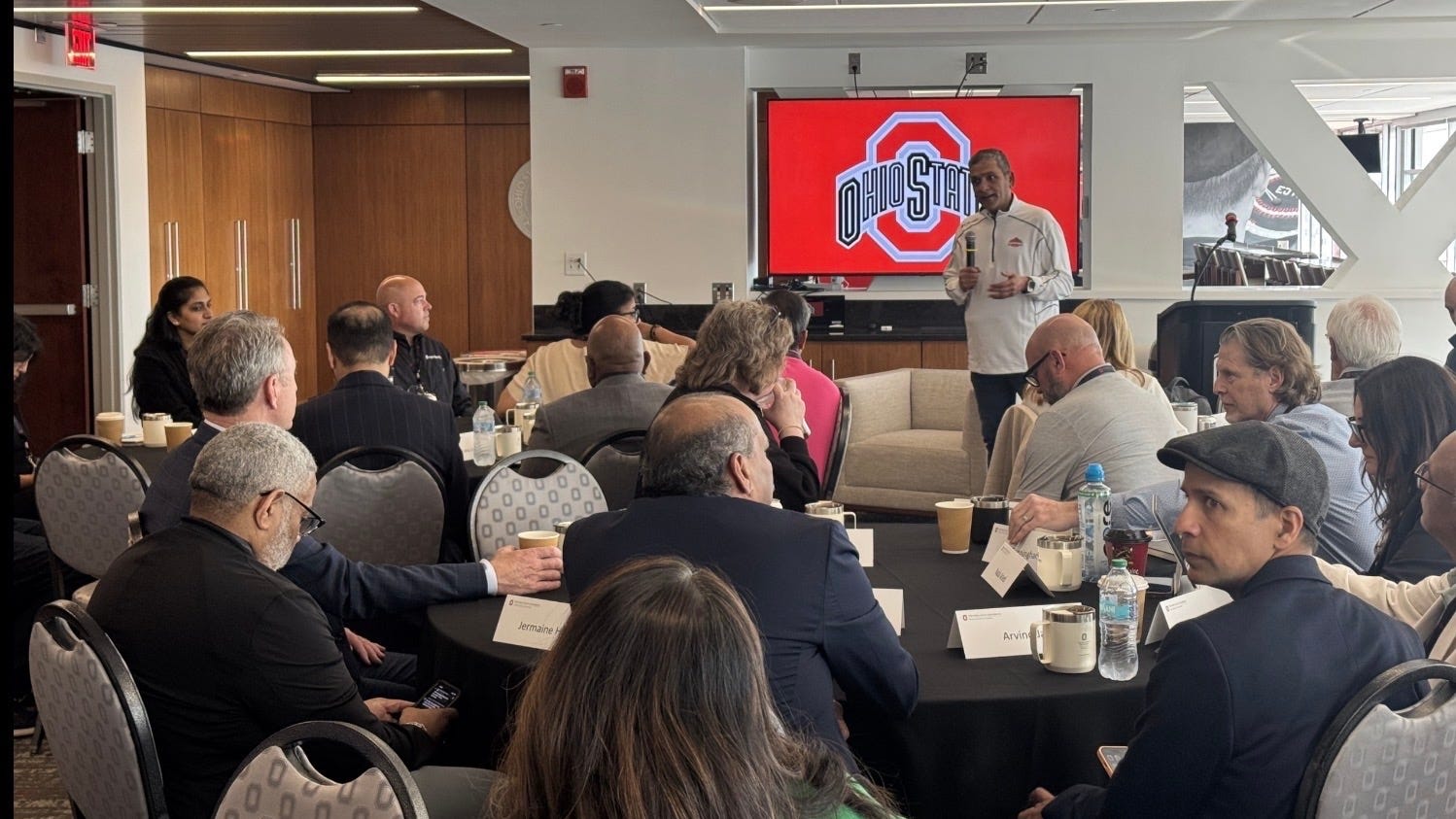
AI Horizons Event at Ohio Stadium
That moment was not an anomaly. I spent nearly a decade in the Valley, starting in 2012, and what I witnessed was a consistent posture: social media technology deployed with full knowledge of its addictive mechanics, choices that put profit before people, and a willful indifference to the income inequality and homelessness compounding on the streets outside those campuses. The cognitive dissonance was extraordinary. Inside the glass buildings, you could watch teams celebrate engagement metrics while outside, a few blocks away, entire communities were being displaced by the wealth those metrics generated. The industry had convinced itself that these were someone else’s problems.
What has changed today is not the behavior. It is the pretense. The same people, running the same playbook on artificial intelligence, are no longer bothering to obscure it. Where social media companies once offered at least the appearance of good intentions, the architects of the current AI wave seem to have concluded that accountability is a constraint to be outrun rather than a responsibility to be honored. The disregard for human cost that used to be spoken quietly in conference rooms is now stated openly, at conferences, in congressional testimony, in press releases. They have decided they no longer need to hide it. That is a meaningful shift, and not in the right direction.
Last week, Pope Leo XIV released his first encyclical, Magnifica Humanitas, forty-two thousand words on safeguarding the human person in the age of artificial intelligence. He grounded it in the 135th anniversary of Rerum Novarum, his namesake Leo XIII’s 1891 response to industrialization, a document that helped shape labor law and social policy across the twentieth century. Leo is making a similar bet: that this moment requires that kind of moral clarity, at that kind of scale.
I am not Catholic, and I am not approaching this document through theology or religious tradition. I am a person of faith who has spent thirty-five years in technology, and I will tell you plainly: this document names what I have watched happen with more clarity and more moral seriousness than anything I have seen come out of Silicon Valley. When an institution with a two-thousand-year view on human dignity takes the time to write a document like this, it deserves to be read, whatever your faith or lack of it.
The encyclical is not anti-technology. It does not argue that AI is evil. What it argues, and gets exactly right, is that technology is never neutral. It takes on the character of the people who build it, finance it, and deploy it. And it warns, with language that should sit uncomfortably in every boardroom currently writing an AI strategy, that the moment efficiency becomes the only metric and optimization replaces judgment, technology stops being a tool and becomes something more dangerous.
Pope Leo draws on an image I keep returning to. Humanity, he writes, faces a choice: construct a new Tower of Babel, or build something where people dwell together. Babel is not a building in a story. It is what happens inside every organization that optimizes for extraction rather than contribution, that treats the concentration of capability and capital as success regardless of what it costs everyone outside the tower. The organizations that have survived and compounded over time did not get there by maximizing extraction. They invested in human capability, built institutional trust slowly, and treated longevity as the measure of success rather than peak valuation. That is the city being built. It is slower and less dramatic than a tower, but it stands.
Here is what I know from thirty-five years in this industry. IBM has been in business for more than a hundred years. Nationwide has been in business for a century. In my work with companies like Safelite and Honda, what I consistently see is that the organizations that put people and human capacity first build something that compounds over time. They earn loyalty that does not have to be bought every quarter. They develop institutional capabilities that cannot be replicated by the next funding round or the next model release. Many of the unicorns that dominated technology headlines over the last decade cannot say the same. A billion-dollar valuation is not a track record. A hundred years of sustained performance is.
The companies I have watched struggle are not struggling despite the choice to treat humans as line items on a spreadsheet. They are struggling because of it. Workforce capabilities never built, institutional knowledge never cultivated, organizational trust never earned. These gaps do not appear in a quarterly report until their absence becomes a crisis. Ruthless, rudderless capitalism is not a strategy. It is a short position on your own future.
My optimism, and I have genuine optimism, comes from what I see in the Midwest. At Ohio State and the universities across this region that are thinking seriously about what AI needs from the people deploying it. At companies treating the question of how humans and AI work together as a leadership issue, not a technology procurement decision. There is an orientation here, a seriousness about people and a longer view of what an organization owes the communities it operates in, that looks less like regional sentiment and more like the thing that makes institutions last.
The encyclical ends by calling on its readers to become builders rather than spectators, to make deliberate choices about technology that reflect what we value rather than simply accepting what the architects of the towers hand us. That is not an aspiration. It is a capability, and like every capability, it must be built intentionally.
I did not build Right Brain Labs because the market needed another AI consultancy. I built it because I sat in that conference room in 2014, and then watched the same logic migrate from social media to artificial intelligence, and decided that someone needed to make the case, plainly and persistently, for the other kind of capitalism. The responsible kind. The sustainable kind. The kind that treats human capacity as the asset it is, not a cost to be managed until it can be automated away. Every time I watch an organization decide that AI is a substitution strategy, I think about that conference room. Every time I watch an organization get it right, building something that makes people more capable rather than less necessary, I think this is what the other path looks like.
The question is not whether AI will reshape every organization in this country. It will. The question is who decides what that reshaping is for.